Patent pending EN 1443 · EN 13084-7 · NFPA 211 Engineering enquiries answered within two working days
engineering@exostack.com
EXOSTACK Modular exhaust stacks
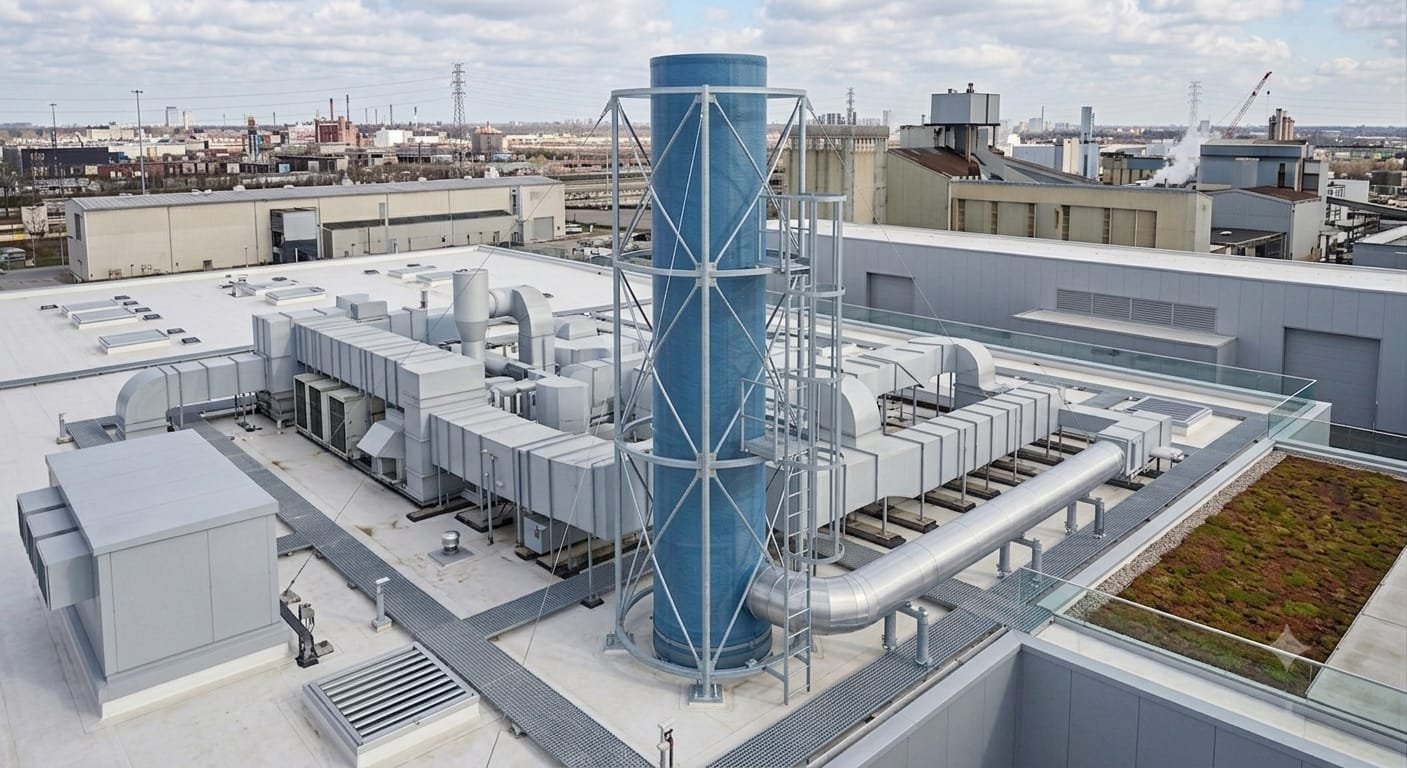
An Exostack unit on an industrial rooftop: a blue PTFE-coated fabric duct held inside an aluminium lattice exo-skeleton, guyed to the roof deck among air handling plant.

A 900 kg chimney problem, solved at 40 kg.

A chimney does two jobs: it holds itself up, and it keeps the gas inside. Exostack stops asking one wall of steel to do both. An aluminium exo-skeleton carries the load on the outside; a replaceable PTFE-coated fabric duct contains the exhaust on the inside. What arrives is two pallets, not a crane booking.

Patent pending EN 1443 T260 N1 W 3–30 m configurable
System mass
40 kg

Complete 7 m × 1 m system. A double-wall stainless equivalent weighs over 900 kg.

Installed cost
€12,500

Option B, 7 m × 1 m, delivered, erected and commissioned. Against roughly €83,000.

Time on site
4 hours

Two engineers, one visit, hand tools. Rigid stacks take three to five days across several.

Lifting plant
None

Every module is under 15 kg and goes up the stairs. No crane, no road closure, no permit.

Why it costs what it costs

The chimney is the cheap part. Getting it onto the roof is not.

Ask a plant engineer what a rooftop stack costs and they will quote you the steel. Then the crane, the structural survey, the secondary steelwork and the road closure arrive, and the project is three times the number in the catalogue. That cost structure was built for a world of cheap labour, open crane access and flat concrete decks — none of which describe a modern industrial roof.

Constraint 01 — access

Nothing gets up there without a crane

A 900 kg stainless stack means a 30–50 tonne mobile crane, a certified operator, two or three riggers and, on a constrained site, a road closure and traffic management plan. That is spent before a single bolt is turned — and on a rooftop the crane cannot reach, it is not a cost at all. It is the end of the project.

€3,500 – 4,500 per lift
Constraint 02 — structure

A trapezoidal roof will not carry it

Trapezoidal sheet decking carries 100–150 kg/m² distributed. A double-wall stainless stack puts many times that through its base plate, plus an overturning moment that has to be traced back to the main frame. The fix is not a detail on a drawing — it is a secondary steelwork package that costs more than an entire Exostack system.

€14,000 – 28,000 in reinforcement
Constraint 03 — permanence

Once it is welded, it is decided

Adding two metres to a stainless stack means a fabricated section, a crane and a coded welder: four weeks and five figures. Moving it costs much the same. So most plants quietly live with a stack in the wrong place, at the wrong height, for the wrong process — because changing it is harder than tolerating it.

€4,000 – 9,000 per height change
The principle

Two jobs. Two elements. Neither compromised by the other.

In a conventional stack, one wall of expensive alloy resists wind load, carries its own weight, survives the acid and lasts thirty years. Every one of those duties pushes the specification — and the price — in a different direction, and the wall has to satisfy the worst of them all at once.

Exostack splits them. The aluminium exo-skeleton on the outside takes dead weight, wind and guy tension, and never meets the flue gas. The fabric duct on the inside meets the flue gas and carries nothing. Each is specified for one duty, and each is optimal at it.

The consequence is the interesting part: because the duct is not structural, it can be replaced in an afternoon without touching the skeleton — and because the skeleton never meets the gas, it outlives several generations of duct.

The system in detail Compare duct specifications
7 m × 1,000 mm installation on trapezoidal steel sheet decking. Stainless figures are 2025 German market rates for CE-marked, 50 mm insulated double-wall product.
On a working roof Double-wall SS316L Exostack
System mass900+ kg40 kg
Heaviest single part180 kg14 kg
CraneAlwaysNever
Roof reinforcementAlmost alwaysNot required
Hot work on siteWelding, permitNone
Time on site3–5 days4 hours
Change the height later€4,000–9,000Add modules
Move it later€3,000–7,000Demount, re-erect
Renew the gas-wetted surfaceReline or replaceSwap the duct
Installed cost≈ €83,000≈ €12,500
Specifications

One skeleton. Three ducts. Specified to your exhaust, not to a catalogue.

The aluminium structure is identical across the range — it never touches the gas, so it has nothing to be resistant to. What changes is the duct: its coating chemistry, its temperature ceiling and its abrasion tolerance are matched to the stream you actually have.

Option A

Silicone-coated E-glass

The value specification for moderate temperatures and mild chemistry — building and HVAC exhaust, generator stacks, food process ventilation.

Continuous230 °C
Acid resistanceDilute only
Duct life8–12 years
Installed, 7 m × 1 m≈ €9,000
Option BMost specified

PTFE inner, PVDF outer

Teflon® inert to essentially every industrial acid, Kynar® outside for 25 years of weather. Where most industrial exhaust lands.

Continuous260 °C
Acid resistanceExcellent
Duct life12–18 years
Installed, 7 m × 1 m≈ €12,500
Option CAbrasive duty

ECTFE on para-aramid

Halar® over a Kevlar® base for streams that are chemically aggressive and abrasive at once — etching, plating, fly ash.

Continuous150 °C
Acid resistanceOutstanding
Duct life15–20 years
Installed, 7 m × 1 m≈ €17,500
Economics

The saving is not in the steel. It is in everything the steel drags with it.

Exostack supply is genuinely cheaper — but roughly half the saving comes from work that simply never happens: no crane, no structural reinforcement, no second and third site visit, no permits for hot work. We publish the whole build-up, line by line, including the cost of replacing the duct at end of life.

Price your own installation See the full breakdown
Supply€35,500 saved — aluminium and coated fabric against 50 mm insulated 316L
Crane€4,800 removed — no module over 15 kg, so nothing needs lifting plant
Roof€19,500 removed — guy wires take the moment, so the deck is left as found
Labour€6,850 removed — one visit by two engineers instead of a five-day multi-trade sequence
Total≈ €70,500 per installation, an 85% reduction on the delivered project cost
Installation

Pallet on the loading bay at eight. Commissioned by one.

Two engineers, standard hand tools and a working-at-height ticket. No crane, no welder, no hot work permit, no second trade waiting on the first. The clock on the left is cumulative — read it down and you have the whole day.

0:00start

Fix the base module to the deck

Set the base module out, drill through the trapezoidal sheet to the purlin below, and anchor with M16 stainless at 150 mm minimum embedment. Connect the process duct to the low-level inlet.

60 minTorque wrench · drill · level
1:00elapsed

Bolt the skeleton up, section by section

Each section is under 15 kg and goes up through a standard roof hatch by hand. Flanges align, M12 stainless torqued in a cross pattern, and the seven-metre skeleton is standing. Nothing is lifted mechanically at any point.

90 minNo lifting plant
2:30elapsed

Set and tension the guy wires

Three pre-swaged 6 mm stainless assemblies clip to the integrated eyelets at two-thirds height and run to their roof anchors. Turnbuckles are brought up in sequence with the supplied gauge until the skeleton reads plumb on both axes.

60 minCalibrated tension gauge
3:30elapsed

Draw the duct over the skeleton

The duct arrives rolled and pre-formed. One engineer receives it at the head while the other feeds from below. Circumferential bands engage at each ring, the inlet collar and head ring are clamped, and the duct takes its cylindrical form as it comes up to tension.

60 minTensioning tool supplied
4:30done

Test, record, hand over

Walk the flanges and seams, verify and log the three guy tensions, check the base for gas-tightness, and complete the installation record — the document the Bezirksschornsteinfeger or your inspection authority will ask for.

30 minCommissioning record issued
Where it goes

Specified for the stream, not for the sector.

The question is never what industry you are in. It is how hot the gas is, what is dissolved in it and what is suspended in it. These are the nine environments Exostack is most often specified into, and the duct each one lands on.

Standards and approvals

We publish where the approvals actually stand.

Exostack is a new product class, and any engineer specifying it will ask what is certified and what is still in the pipeline. Rather than make you dig for it, the status of every approval is on the page — complete, in progress or planned — and it is updated as each one moves.

Structural design to EN 1993-3-2 and ASCE 7 is complete, and the EN 1443 classification is settled at T260 N1 W. DIBt national technical approval and CE marking are the live workstreams; NFPA 211 and UL 1777 listings follow in the United States.

Every standard, with status
European Union
EN 1993-3-2 structuralComplete
EN 1443 classificationComplete
IED dispersion methodComplete
DIBt approval (abZ)In progress
CE markingIn progress
EN 13501-1 fire testPlanned
United States
ASCE 7 wind designComplete
EPA stack methodComplete
OSHA manual handlingCompliant
NFPA 211 listingIn progress
UL 1777 listingIn progress
NRTL fire testingPlanned
Next step

Tell us about the stream. We will tell you if this fits.

Four short steps — what the process is, what comes out of it, how big the stack has to be and where to reach you. An engineer reads every one, and if Exostack is the wrong answer for your exhaust we will say so rather than sell you the nearest option.

ReplyWithin two working days, from an engineer rather than a mailbox
You getA specification recommendation, an indicative installed price and the structural basis behind it
CostNothing, and no obligation — the assessment is yours either way
Price it Request a quote